

Crude Oil
Crude oil remains the backbone of the modern global energy system. Despite the growing discussion around renewable energy sources such as solar and wind power, the reality is that a large share of the world’s economy continues to depend on it. Transportation, heavy industries, chemical manufacturing, pharmaceuticals, plastics, and lubricants are all directly or indirectly derived from it. In 2026, crude oil still plays a decisive role in shaping global energy security, economic stability, and geopolitical strategies.
What Is It?
It is a naturally occurring, unrefined mixture of hydrocarbons formed over millions of years due to extreme heat and pressure beneath the Earth’s surface. It is primarily composed of carbon and hydrogen atoms and is found trapped within underground geological formations. Because it is unprocessed, it cannot be used directly in its natural form.
Before it becomes useful, it must undergo refining. In refineries, it is transformed into valuable products such as petrol, diesel, jet fuel, liquefied petroleum gas (LPG), asphalt, lubricants, and petrochemical feedstocks. This entire transformation process is known as the refining process.
Crude oil is a naturally occurring, unrefined mixture of hydrocarbons formed over millions of years due to extreme heat and pressure beneath the Earth’s surface. It is primarily composed of carbon and hydrogen atoms and is found trapped within underground geological formations. Because crude oil is unprocessed, it cannot be used directly in its natural form.
Before crude oil becomes useful, it must undergo refining. In refineries, crude oil is transformed into valuable products such as petrol, diesel, jet fuel, liquefied petroleum gas (LPG), asphalt, lubricants, and petrochemical feedstocks. This entire transformation process is known as the refining of crude oil.
Classification
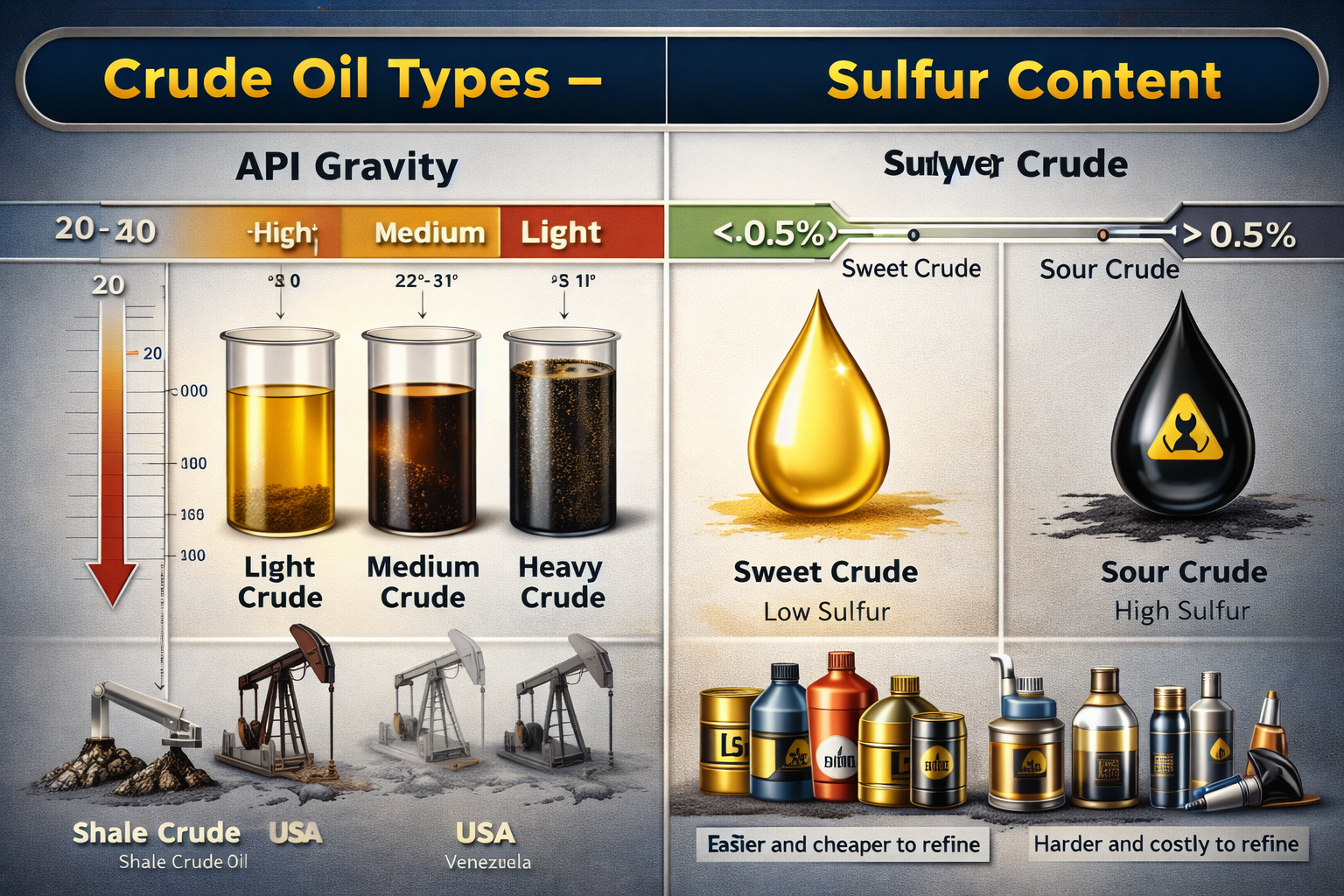
API Gravity (American Petroleum Institute)
API gravity is a measure of how heavy or light it is compared to water. Based on API gravity, it is broadly divided into three main categories.
Sulfur Content: Sweet vs Sour
Crude oil is also classified based on sulfur content. Sweet crude oil contains low sulfur and is easier and cheaper to refine. Sour crude oil has higher sulfur content, making its refining process more complex and expensive due to the need for additional desulfurization units.
Other Technical Properties
Several additional factors influence crude oil quality and pricing. These include Total Acid Number (TAN), metal content such as nickel and vanadium, and wax content. These properties affect transportation, storage, refinery configuration, and overall processing costs.
Major Global Benchmarkies
In international oil markets, specific crude oil grades serve as pricing benchmarks. Brent crude is the most widely used global benchmark. WTI (West Texas Intermediate) represents light sweet crude from the United States. Other important benchmarks include Arab Heavy, Maya, Urals, and Merey, which represent heavier or sour crude grades. These benchmarks guide global oil pricing and trade flows.
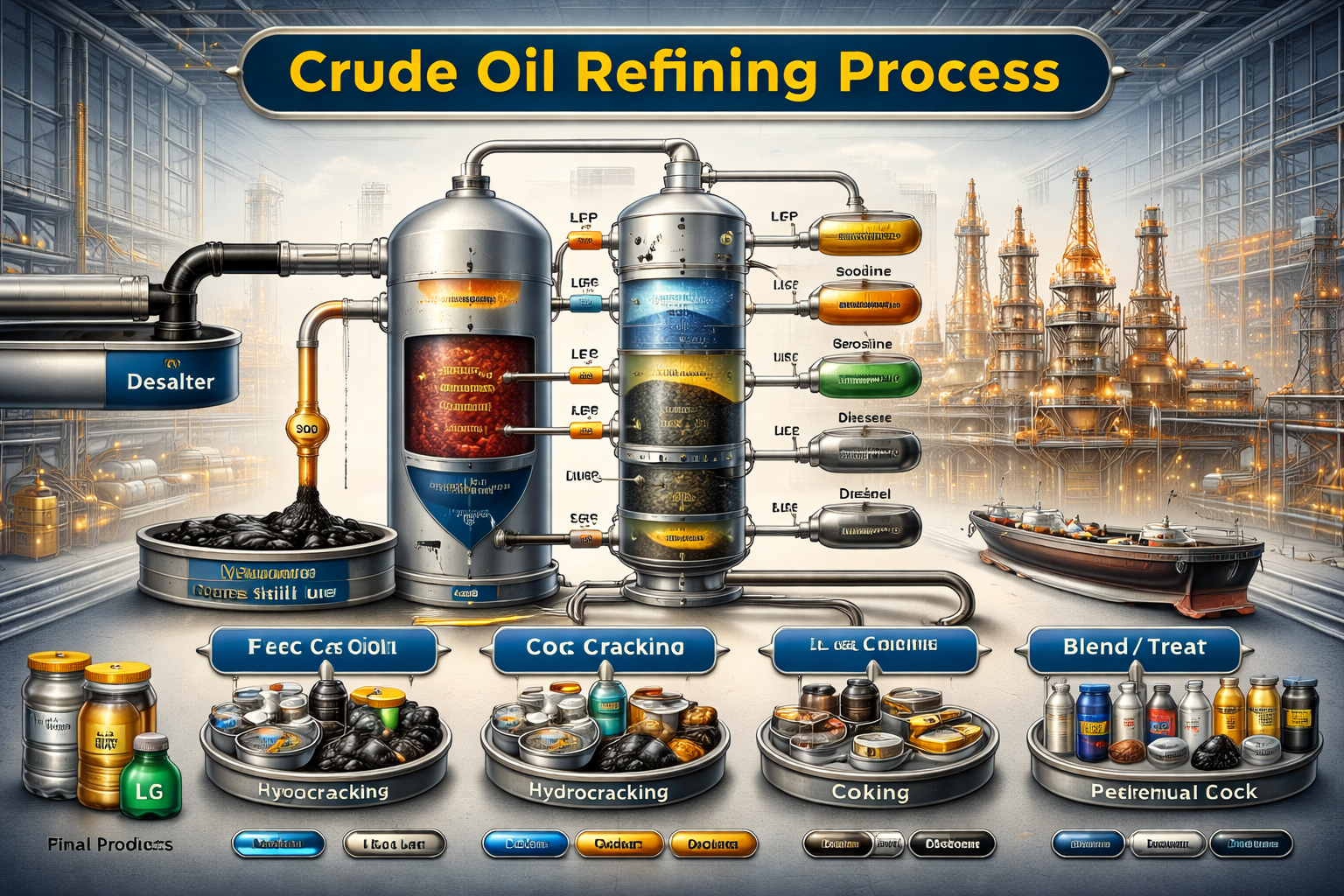
The Refining Process
Refineries are industrial facilities where crude oil is converted into usable products through a series of technical and chemical processes. The refining process begins with desalting and pre-treatment to remove salt, water, and impurities. This step protects equipment and improves processing efficiency.
Next, crude oil undergoes atmospheric distillation, where it is heated and separated into fractions such as gas, naphtha, kerosene, diesel, and gas oil. Heavier residues are then processed in vacuum distillation units under reduced pressure.
Conversion units play a critical role in modern refineries. Fluid catalytic cracking breaks heavy molecules into petrol-range products. Hydrocracking uses hydrogen and catalysts to produce high-quality fuels. Coking converts heavy residues into lighter products and petroleum coke. Finally, treating and blending remove sulfur and other impurities and ensure products meet regulatory standards.
Refinery Configuration and Selection
The design of a refinery depends on the type of crude oil it processes. Simple refineries are optimized for light sweet crude oil because it requires minimal complex processing. Complex refineries are designed to handle heavy sour crude oil, which contains more sulfur and heavy molecules. These refineries rely on hydrocracker and coker units, which are capital-intensive but highly effective. This difference in refinery capability explains why crude oil prices vary across global markets.
Shale Production in the United States
In the United States, a significant portion of crude oil production comes from shale formations. Shale crude oil is extracted using hydraulic fracturing and horizontal drilling techniques. It is generally light and sweet, with low sulfur content, making it easier to refine. Shale crude oil yields higher quantities of petrol and jet fuel. Major shale oil regions include the Permian Basin, Bakken, and Eagle Ford.
Heavy Production in Countries Like Venezuela
Countries such as Venezuela primarily produce heavy crude oil. This type of crude is dense, sulfur-rich, and contains high metal content. Heavy crude oil has low API gravity and is classified as sour crude. Refining heavy crude is expensive and requires advanced technologies such as coking and hydrocracking.

Environmental and Regulatory Challenges
The crude oil industry faces increasing pressure from ultra-low sulfur fuel regulations, carbon emission reduction targets, and the global energy transition. Refineries are being forced to adopt costly but environmentally friendly technologies. At the same time, the shift toward cleaner energy sources is reshaping long-term crude oil demand.
Conclusion
It remains central to the global economy in 2026. Shale production has strengthened the United States as a leading producer, while countries dependent on heavy production face greater technical and political challenges. Although the importance of it may gradually decline in the long term, it will continue to play a critical role in the global energy system for decades to come.
Crude oil remains central to the global economy in 2026. Shale crude oil has strengthened the United States as a leading producer, while countries dependent on heavy crude face greater technical and political challenges. Although the importance of crude oil may gradually decline in the long term, it will continue to play a critical role in the global energy system for decades to come.
Pingback: What Are Personality Rights? -
Pingback: Artificial Intelligence (AI) -