Greenland’s Geopolitics

The Great Arctic Game: A Deep Dive into Greenland’s Future
Greenland—the world’s largest island—has always existed on the edges of global attention. Vast, frozen, and sparsely populated, it was long seen as distant from the real centers of power. That perception no longer holds.
As we move through 2026, Greenland has stepped directly into the spotlight of global geopolitics. Not because it sought attention—but because history, geography, and climate change dragged it there. What looks like a frozen wilderness on the map has become one of the most strategically valuable territories on Earth.
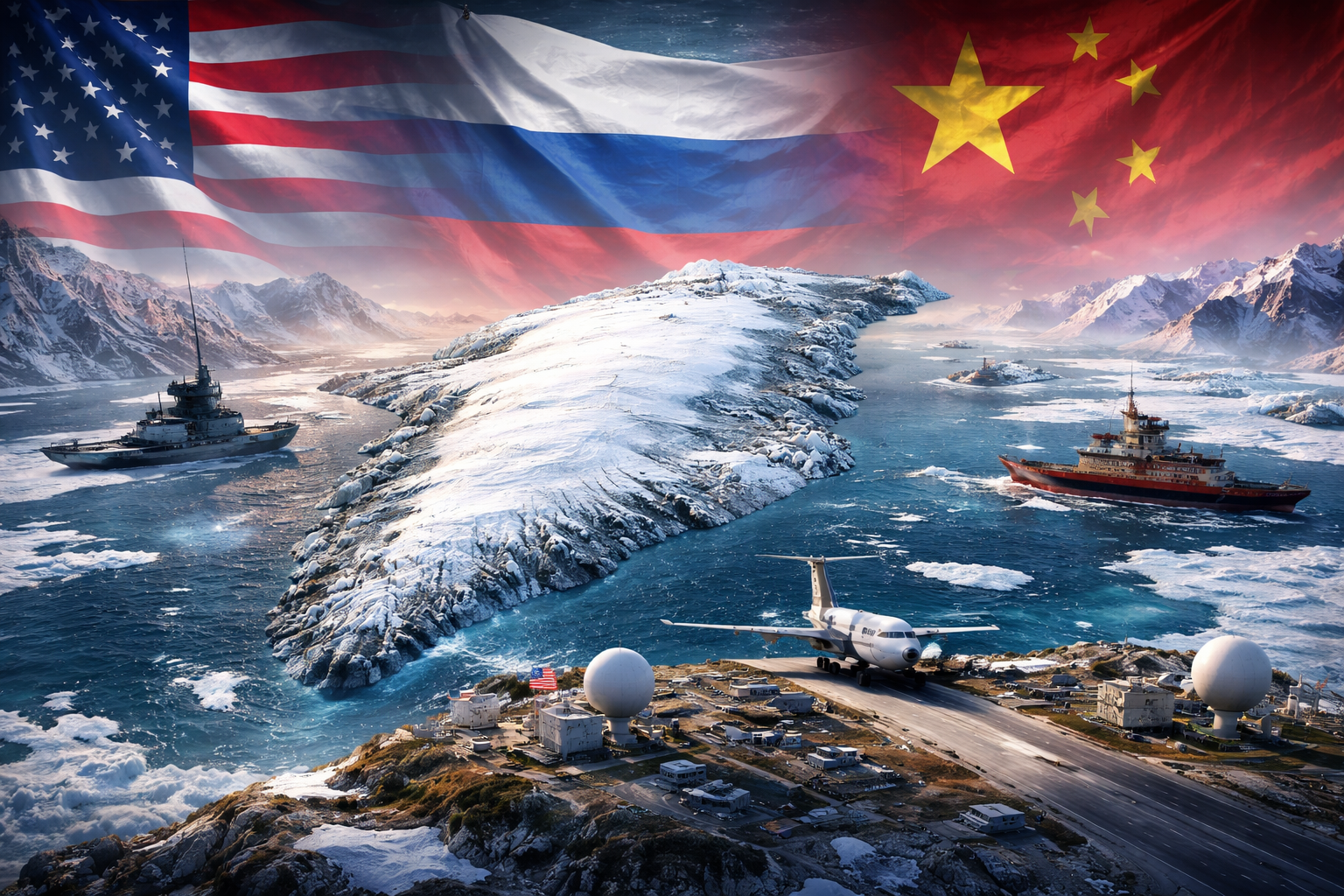
This is no longer just about ice melting. It is about power shifting. A new Arctic Cold War is quietly unfolding, driven by competition between the United States, Russia, and China.
From U.S. congressional bills proposing Greenland’s acquisition to the discovery of mineral resources worth trillions of dollars, Greenland is no longer just an autonomous territory under Denmark. It has become a strategic prize of the 21st century.
1. Geographic Position: The “Top of the World”
If power in global politics starts with geography, then Greenland is holding one of the strongest cards.
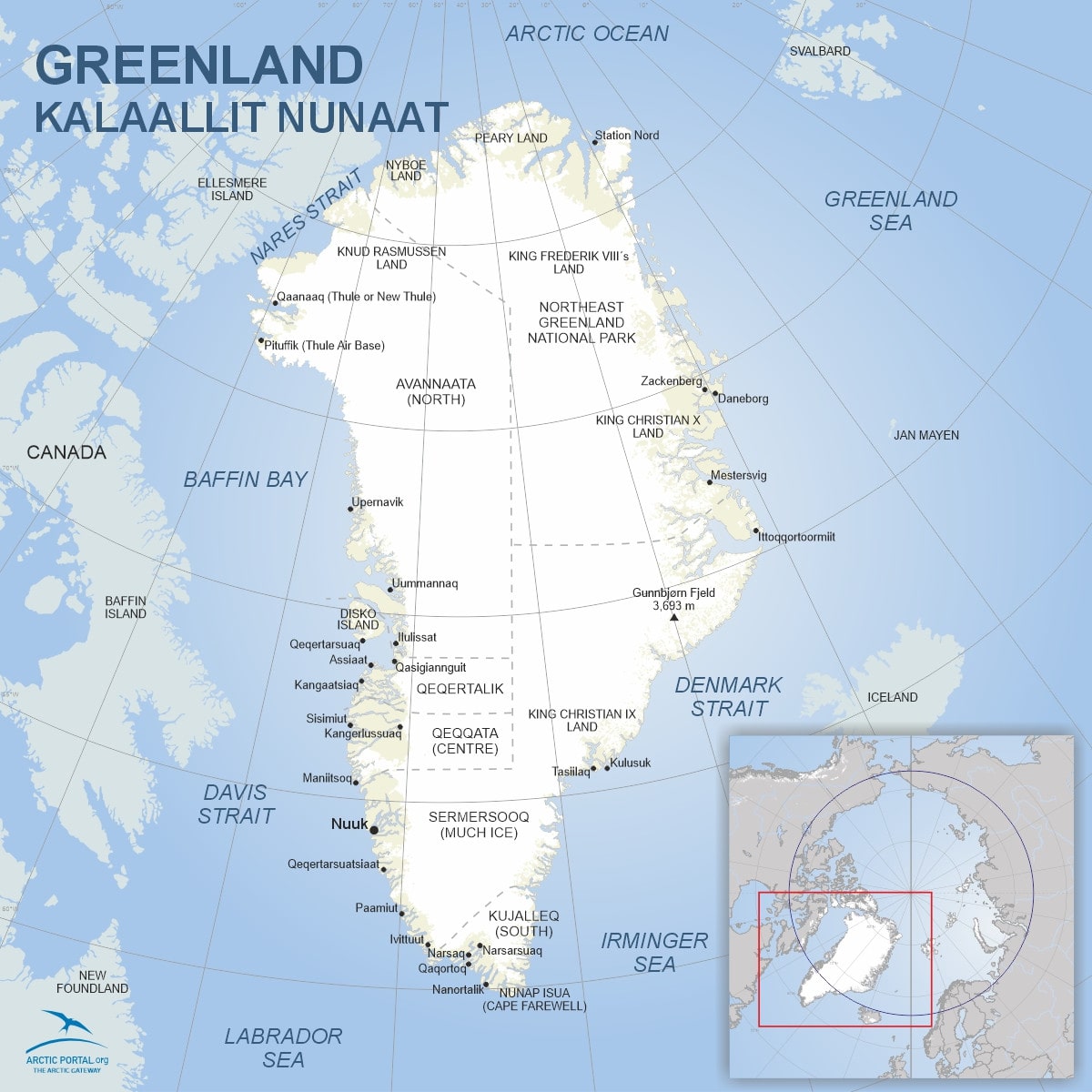
Positioned between the North Atlantic and the Arctic Oceans, Greenland forms a natural bridge between North America and Europe. No other landmass in the Arctic offers such direct control over airspace, sea lanes, undersea routes, and polar missile trajectories at the same time.
The Strategic GIUK Gap
At the core of Greenland’s military importance lies the GIUK Gap—the Greenland–Iceland–United Kingdom corridor. This narrow maritime and undersea passage is the only practical route through which Russia’s Northern Fleet can move from the Arctic into the open Atlantic.
During the Cold War, this gap was obsessively monitored. In 2026, it matters even more.
From Greenland, NATO can:
Track Russian ballistic missile submarines
Deploy undersea sonar networks
Monitor hypersonic missile paths
Secure Atlantic reinforcement routes
Simply put, without Greenland, NATO’s Atlantic defense would be dangerously blind.
2. History & the Danish Connection
Greenland’s relationship with Denmark is old, complex, and evolving.
Since the 18th century, Greenland has been part of the Danish realm. But over the decades, control has steadily shifted closer to Nuuk:
1953: Colonial status ended; Greenland became a Danish province
1979: Home Rule granted authority over internal affairs
2009: Self-Government expanded autonomy further
Today, Greenland controls its:
Natural resources
Judiciary
Policing and internal governance
Denmark retains responsibility for:
Foreign affairs
Defense
Currency
An annual block grant of roughly $600 million still supports Greenland’s economy, accounting for nearly half of public spending. Independence is politically popular—but economically complicated.
3. Why America Wants Greenland: The 51st State Question
By 2026, a question once dismissed as absurd is now openly discussed:
Could Greenland become America’s 51st state—or something close to it?
The “Make Greenland Great Again Act”
On January 13, 2025, the U.S. Congress introduced the Make Greenland Great Again Act (H.R. 361). In early 2026, this was followed by the Greenland Annexation and Statehood Act, proposed by Rep. Randy Fine.
These initiatives seek to:
Authorize negotiations for acquiring Greenland
Map potential paths to territorial or state status
Establish a Compact of Free Association (COFA)
Why Washington Cares So Much
National Security
The U.S. already operates the Pituffik Space Base (formerly Thule), a cornerstone of missile early-warning and space surveillance systems.
Missile Defense Strategy
President Donald Trump has prioritized polar missile interception. Greenland’s geography makes it irreplaceable for tracking threats crossing the North Pole.
Arctic Shipping Control
Melting ice has opened the Northern Sea Route, challenging the dominance of traditional trade corridors like the Suez Canal.
Public Reality Check
Despite U.S. interest, a January 2026 poll showed 85% of Greenlanders oppose joining the United States, preferring independence or remaining linked to Denmark.
This alone makes outright statehood politically unrealistic.
4. Rare Earth Elements & Oil: The Trillion-Dollar Layer Beneath the Ice
Greenland’s strategic value is not just about location. It is also about what lies beneath the ice.
Rare Earth Elements (REEs)
Greenland hosts some of the world’s largest untapped reserves of Neodymium, Dysprosium, and other REEs—critical for:
Electric vehicles
Wind turbines
Advanced electronics
Military systems
Projects like Tanbreez and Kvanefjeld have the potential to weaken China’s near-monopoly over rare earth supply chains. In January 2026, pilot-scale processing at Tanbreez marked a symbolic but important milestone.
Still, this is not a quick win. Arctic mining is expensive, politically sensitive, and environmentally risky.
Oil & Gas
Estimates suggest 17–50 billion barrels of oil offshore. Although exploration was halted in 2021 due to environmental concerns, the energy crisis of 2024–25 has quietly reopened the debate.
Greenland now stands at a crossroads between climate responsibility and economic survival.
5. Climate Change: The Accelerator No One Can Ignore
Climate change is not just background noise in Greenland’s story—it is the force speeding everything up.
Shrinking ice coverage has:
Enabled near year-round Arctic navigation
Cut Asia–Europe shipping times by up to 40%
Blurred the line between commercial trade routes and military patrol zones
The influence of the Arctic Council has weakened, especially after Russia’s political isolation. Cooperation has given way to competition.
Greenland now represents a paradox that defines the modern world:
The same climate crisis threatening its environment is unlocking its strategic and economic value.
6. Indigenous Inuit Voices: What Power Politics Often Miss
In the middle of this global competition stands Greenland’s Inuit population.
Groups such as the Inuit Circumpolar Council have consistently warned that development without consent risks cultural and environmental damage.
For Inuit communities:
Land equals identity
Hunting routes are livelihoods
Language is survival
Mining projects and military expansion threaten traditions that have endured for centuries. Ignoring these voices risks repeating colonial patterns—this time justified by security and economics.
7. The Geopolitical Chessboard: Russia, China & India
Russia
Russia has aggressively militarized the Arctic, reopening Soviet-era bases and expanding submarine patrols. U.S. moves in Greenland are seen as a direct strategic challenge.
China
Calling itself a “Near-Arctic State,” China has pursued infrastructure and mining access. Although blocked politically, Beijing’s economic interest remains strong.
India
India has entered quietly, focusing on scientific cooperation and mineral security to support its green-energy ambitions.
8. Europe, NATO & Strategic Anxiety
Greenland left the European Community in 1985 but remains linked to the European Union.
European leaders fear that U.S. annexation would:
Undermine NATO unity
Remove Europe’s Arctic buffer
Set a dangerous precedent
Danish Prime Minister Mette Frederiksen warned that forced annexation would “end NATO.”
9. Legal Reality Check: Why Annexation Remains Unlikely
Under the United Nations Charter, the right to self-determination makes forced annexation legally unviable.
Any change in Greenland’s status would require:
A referendum among Greenlanders
Danish approval
Full compliance with international law
A Compact of Free Association (COFA) remains the most realistic framework—strategic access without sovereignty transfer.
10. Scenario Forecast (2026–2035): Three Paths Forward
1. Independence with a Mining-Led Economy
Economic freedom, environmental risk.
2. Denmark + NATO Strategic Hub
Security stability, limited autonomy.
3. U.S. COFA Model
Political independence with American defense dominance.
Each path reshapes not just Greenland—but the Arctic balance itself.
Conclusion: A New Arctic Reality
Greenland is no longer a silent, frozen outpost. It is awake—and the world is watching.
Whether it chooses independence, deeper Danish ties, or a strategic partnership with the United States, one thing is certain: Greenland’s future will shape global security, climate politics, and energy transitions for decades to come.
The world order is being rewritten in Arctic snow—and Greenland is holding the pen.