
Artificial Intelligence (AI); Understanding the Technology That Is Quietly Shaping Our Future
Artificial Intelligence, commonly known as AI, is no longer a buzzword limited to tech experts or science fiction movies. It has slowly and steadily become a part of our everyday lives. From unlocking our smartphones to recommending what we watch next, AI works behind the scenes, making life easier, faster, and more personalized.
In simple terms, Artificial Intelligence is the ability of machines or computer systems to think, learn, and make decisions in ways that resemble human intelligence. What makes AI truly powerful is not just speed, but its ability to learn from data and improve over time.
This blog aims to explain Artificial Intelligence in a clear, human way—so that by the end, you don’t just know what AI is, but you truly understand how it works, where it is used, and why it matters.
The Evolution of Artificial Intelligence
The idea of Artificial Intelligence began with a simple but bold question:
Can machines think like humans?
This question led researchers, as early as the 1950s, to explore whether computers could imitate human reasoning. Over time, advancements in computing power, access to massive amounts of data, and smarter algorithms transformed AI from a concept into reality.
Today’s AI systems are built on years of research in mathematics, logic, and cognitive science. Just like humans learn from experience, AI systems learn from data, becoming smarter with every interaction.
How Artificial Intelligence Works
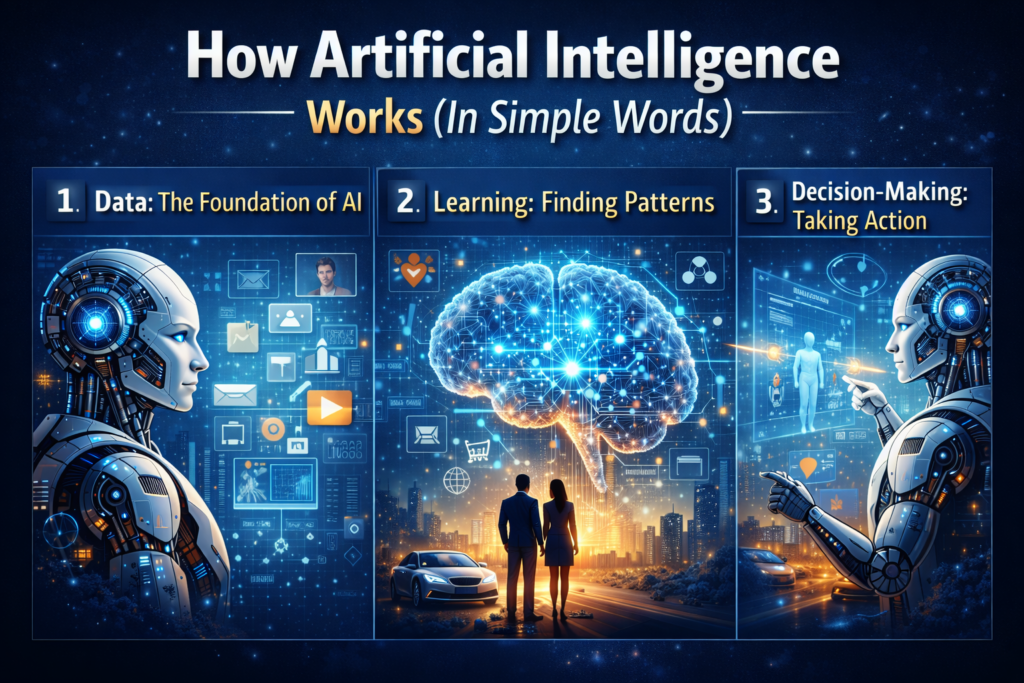
At its core, AI operates through three essential elements:
Data: The Foundation of AI
AI depends entirely on data. This data can be text, images, videos, voice recordings, or numerical information. The more relevant data an AI system receives, the better it performs.
Learning: Finding Patterns
Using learning algorithms, AI analyzes data to identify patterns. For example, it learns which emails are spam, which photos contain faces, or which products a user might like.
Decision-Making: Taking Action
Once trained, AI can make decisions on its own—without human input every time. This ability to act independently is what makes AI so effective and scalable.
Over time, AI systems refine their performance, much like humans improve skills through practice.
Types of Artificial Intelligence
Artificial Intelligence can be categorized based on how intelligent and capable it is.
Narrow AI
This is the most common form of AI today. Narrow AI is designed to perform a single task or a specific set of tasks. It does not possess general understanding or awareness.
Examples include voice assistants, recommendation engines, and facial recognition systems.
General AI
General AI refers to machines that can think, learn, and perform tasks across multiple domains—similar to human intelligence. This level of AI is still under development and does not yet exist in practical form.
SuperAI
Super AI is a theoretical concept where machines surpass human intelligence in every area, including creativity, reasoning, and emotional understanding. While fascinating, it also raises serious ethical and safety concerns.
Where We Use Artificial Intelligence Today
AI in Everyday Life
Smartphone security features
Voice-based commands
Smart camera enhancements
Personalized social media feeds
It adapts to user behavior, making technology feel more intuitive.
AI in Healthcare
Healthcare has seen major improvements through AI:
Early detection of diseases
Faster analysis of medical reports
Support during complex medical procedures
AI helps doctors make more accurate and timely decisions.
AI in Education
Education is becoming more personalized:
Online learning platforms adapt to student needs
Customized study plans
Automated assessments and feedback
Students can now learn at their own pace, with greater flexibility.
AI in Transportation and Smart Cities
AI is reshaping urban living:
Intelligent traffic systems
Accident prediction and prevention
Smarter energy and resource management
Cities are becoming safer, cleaner, and m
Advantages of Artificial Intelligence
AI offers several clear benefits:
Saves time by automating repetitive tasks
Improves accuracy by reducing human error
Boosts productivity across industries
Handles risky tasks in dangerous environments
By reducing routine workload, AI allows humans to focus on creativity, strategy, and innovation.
Challenges and Risks of Artificial Intelligence
Despite its benefits, AI is not without concerns:
Job displacement due to automation
Privacy issues related to data usage
Overdependence on machines
Ethical dilemmas about accountability and bias
These challenges highlight the need for thoughtful and responsible AI development.
Ethics and Responsibility in Artificial Intelligence
Artificial Intelligence itself is neutral—it reflects the intentions of those who design and use it. Responsible AI requires:
Clear human oversight
Strong data protection laws
Transparency in decision-making
Ethical guidelines ensure that AI remains a tool for progress, not a source of harm.
The Future of Artificial Intelligence
Looking ahead, AI is expected to:
Create new career opportunities
Power smart cities and advanced infrastructure
Make healthcare and education more accessible
Strengthen collaboration between humans and machines
The goal is not to replace humans, but to enhance human potential.
Conclusion: Artificial Intelligence as a Tool, Not a Threat
Artificial Intelligence is neither inherently dangerous nor automatically beneficial. It is a powerful technology that reflects how wisely it is used. When guided by ethics, regulation, and human values, AI has the potential to improve lives on a global scale.
The true future of Artificial Intelligence depends not on machines,
but on the responsibility and vision of the people behind them.